Information for Authors
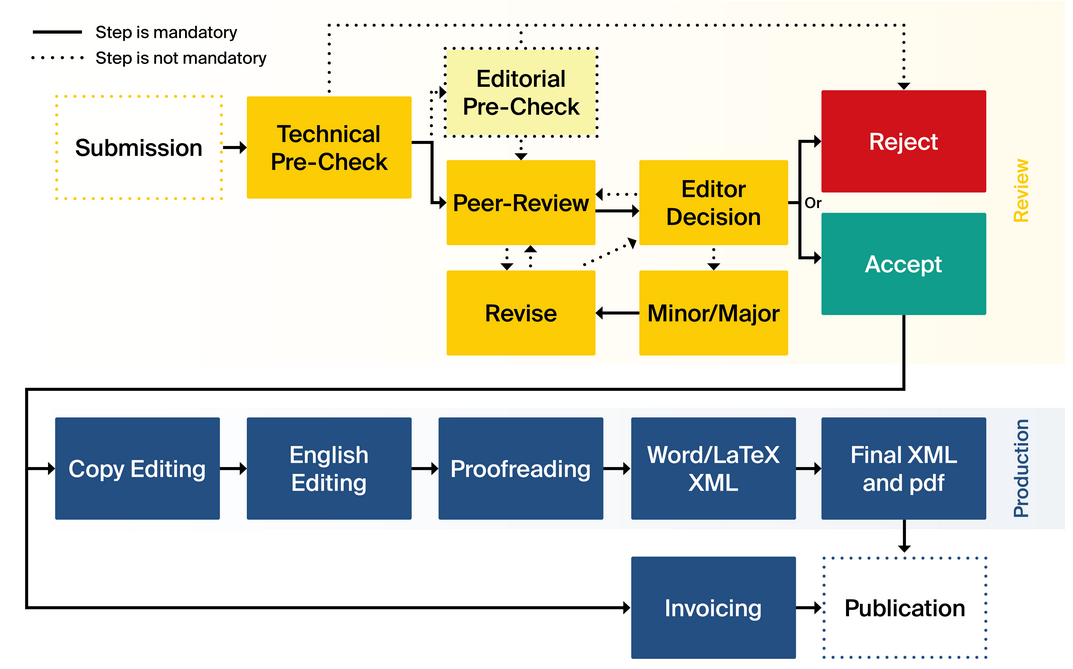
All manuscripts sent for publication in our journals are strictly and thoroughly peer-reviewed by experts (including research/review articles, spontaneous submissions, and invited papers). The Managing Editor performs a technical pre-check upon receipt, followed by an editorial pre-check by the academic editor. The Editorial Office organizes the peer-review process, collecting at least two review reports per manuscript. Authors can view the progress and preliminary reviewer reports in real-time via the platform.
Note: Authors are recommended to refrain from undertaking revisions until the official notification is received. The final decision is made by the academic editor (Editor-in-Chief, Editorial Board Member, or Guest Editor).
Manuscript Preparation Guidelines
- 1
File Format: Single PDF or MS Word document (including text, references, tables, figures). Revised manuscripts must be editable Word documents. LaTeX is accepted but must be PDF for initial review.
- 2
Structure: English language. Order: Title Page (Title, Authors, Affiliations), Abstract (100-300 words), Keywords (3-5), Introduction, etc.
- 3
Figures & Tables: JPG/TIF figures at 500 dpi. Tables (Word/Excel) and Equations (Equation Editor) must be editable text, not images. Number sequentially (Figure 1, Table 1).
- 4
Formatting: Single spaced, 10 pt Palatino Linotype font for all text elements. This standardizes the review process and reduces paper usage.
- 5
Citations: Numbered in square brackets [1] in text and listed in appearance order in the References section.
Reference Styling Examples
Editorial Decision and Revision
All articles go through peer-review with at least two reports. Decisions are communicated as follows:
Digital Preservation
Content is permanently archived in the CLOCKSS archive. We maintain copies of submitted manuscripts for record-keeping.
Copyright & License
Articles are published under the Creative Commons Attribution (CC BY 4.0) license. Authors retain copyright while allowing reuse with citation.